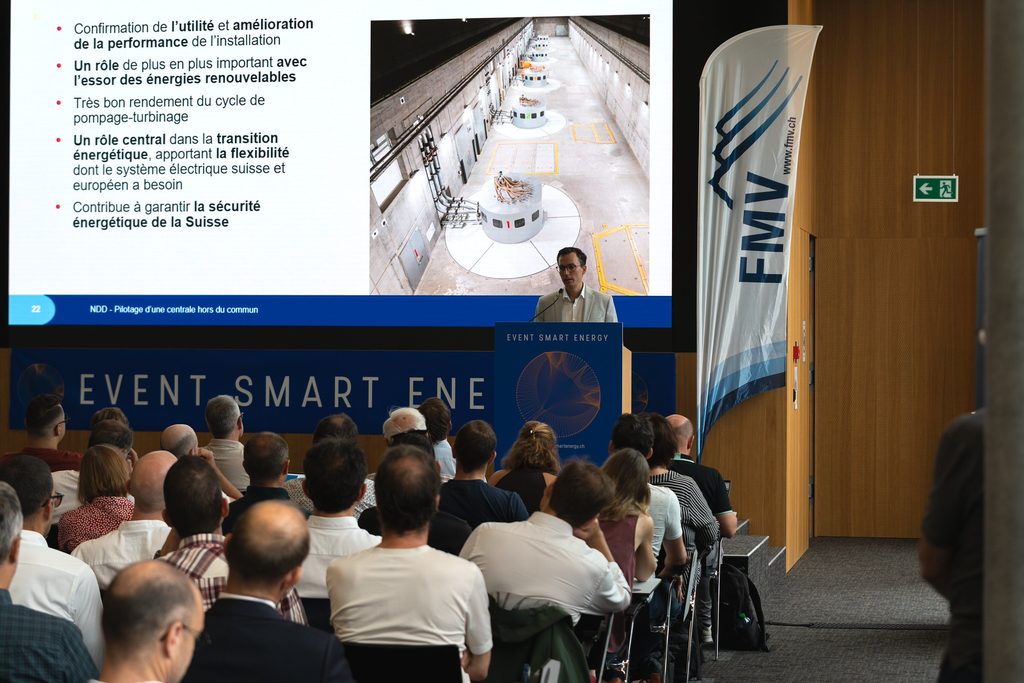
It is one of the most powerful pumped-storage power plants in Europe. At the Smart Energy 2026 event in Sion, its director, Jeremy Urech, discussed the early years of operation at Nant de Drance and the plant’s role in stabilizing the Swiss and European power grids.
Located between Lake Emosson, at an elevation of 1,930 meters, and Lake Vieux Emosson, at 2,225 meters, the Nant de Drance power plant functions like a giant battery. Its storage capacity is 20 GWh, or 20 million kilowatt-hours. “To give you an idea of the scale, a single fill-up would be enough to power more than 4,000 households for a year or to power 8,000 electric vehicles for a year,” according to figures presented by Jeremy Urech.
For the entire year of 2025, the volume generated reached 1 TWh, “which is equivalent to 200,000 Swiss households or 400,000 vehicles—nearly twice the number of electric vehicles in Switzerland.”
Unmatched flexibility
The strength of Nant de Drance lies not only in its storage capacity, but also in its flexibility. Its six variable-speed generating units provide excellent efficiency, precise control in both turbine and pump modes, and even compensator operation—that is, voltage regulation without pumping or turbine operation.
The plant’s sheer scale is staggering. In one minute, the power plant fills “a little less than ten Olympic-sized swimming pools.” And the redundancy provided by the six units also offers a practical advantage during maintenance operations, as the director points out.
Cycles Determined by the Sun
During its early years, the power plant adapted its operations to market conditions. In April 2026, the week still followed a weekly cycle: generating power on weekdays, when prices were high, and then refilling the reservoir on weekends. A month later, the situation had changed. “Significant fluctuations—due primarily to high solar generation—required a purely daily cycle, with power generation in the morning and evening, and pumping during the day.”
“The advantage of having a 20 GWh ‘battery’ and high capacity is that we can take advantage of opportunities. In addition, we can provide grid-balancing services through turbine generation, pumped storage, and also in compensator mode.”
Summer brings its share of surprises. With the heat wave, electricity consumption rises and nuclear capacity decreases, driving prices up. “The gap remains, but it’s generally smaller. Nevertheless, there are some great opportunities for our plant, particularly through balancing services,” the director explains.
The availability of the power plant in question
“One of the major challenges for Nant de Drance is the plant’s availability,” the director emphasizes. Unlike a storage power plant, the loss of an opportunity—and thus a pumped-storage cycle—is a “direct net loss” that cannot be made up for later. As a result, at least one generating unit has been operating at 90% capacity or higher since early 2026.
The financial stakes are high. Annual expenses total nearly 91 million francs, including 40 million in depreciation and debt-related financial expenses. “That accounts for about three-quarters of our expenses,” says Jeremy Urech. To reduce the cost of goods sold, we must therefore increase production and keep the production line as available as possible.
To this end, the power plant relies on a balanced preventive maintenance program, as well as modern tools capable of anticipating incidents: predictive maintenance, digital twins of the facility, and so on.
The network: the limiting factor
The plant’s availability also depends on the grid. Currently, grid congestion is causing power output restrictions at Nant de Drance. When work is being performed on certain components, the plant cannot feed all of its power into the grid and is subject to restrictions based on the “last in, first restricted” principle. “It is therefore very important to complete the necessary expansions to the extra-high-voltage grid as quickly as possible, particularly on the 380-kV Chippis–Bickigen and Chippis–Lavorgo lines,” argues Jeremy Urech.
The facility’s performance also depends on its teams. As of January 1, 2025, Hydro Exploitation has taken over full operation of the power plant. “High availability necessarily depends on the skills and expertise of the operations teams,” notes the director, who emphasizes training and working conditions to prevent high turnover.
Flexibility, therefore, does not stop at the machine. “Flexibility in plant design equals flexibility across the entire value chain,” concludes Jeremy Urech, who calls for ongoing coordination among all stakeholders, from the local operator to the trader responsible for marketing energy 24 hours a day, 7 days a week.
Quotes taken on August 28, 2026, during the Smart Energy Event